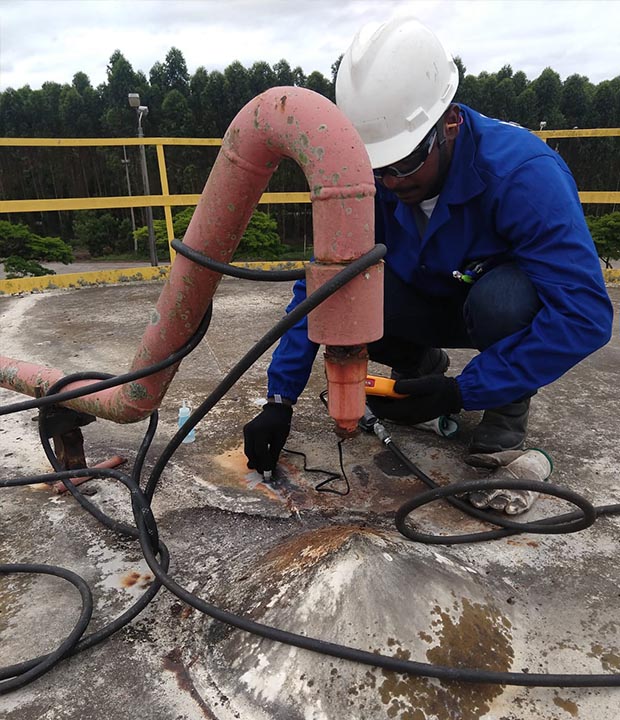
Regulatory Standard NR-13 is more than a set of regulations; it is a pillar of safety and compliance in industry. Established by Brazil’s Ministry of Labor and Employment, this standard has a clear focus: to ensure the safety and integrity of pressure vessels and boilers in industrial facilities.
NR-13 is an essential guideline for industry, and its importance cannot be underestimated. It establishes minimum requirements for the safe operation of pressure vessels and boilers, aiming to prevent accidents, protect workers and preserve facilities.
NR-13 covers several types of inspection to ensure safety and compliance. Some of the main tests specified in NR-13:
Visual Testing (VT): Visual testing involves a careful visual inspection of the equipment surface in search of visible defects such as cracks, fissures, corrosion and wear. It is the first step and can identify obvious problems.
Liquid Penetrant Testing (PT): Liquid penetrant testing is used to detect surface cracks and discontinuities in metallic materials. It consists of applying a penetrant liquid to the material surface and removing the excess, followed by the application of a developer that highlights the discontinuities.
Magnetic Particle Testing (MT): Magnetic particle testing is used to detect surface and subsurface defects in ferromagnetic materials. It consists of applying magnetic particles to the material surface and observing magnetic flux patterns to identify discontinuities.
Ultrasonic Testing (UT): Ultrasonic testing uses high-frequency sound waves to assess wall thickness and detect internal defects such as cracks and inclusions. It is a valuable technique for assessing the thickness of pressure vessels.
Radiographic Testing (RT): Radiographic testing involves exposing the material to X-rays or gamma rays, producing a radiographic image that reveals internal discontinuities such as cracks, inclusions and defective welds.
Phased Array Ultrasonic Testing (PAUT): This advanced ultrasonic technique uses an array of transducer elements to inspect materials more efficiently, allowing precise detection and sizing of defects.
Eddy Current Testing (ECT): Eddy current testing is used to detect surface cracks and electrical conductivity defects in conductive materials. It is especially useful for inspecting tubes and metal surfaces.
Tecnoend, committed to safety and compliance, has a team of NR-13 specialists that offers inspection and consulting services to help companies meet these crucial regulations.
To learn more about how NR-13 affects your company and how Tecnoend can help you, contact us or visit our website.
